


Long weekends, a BBQ in the garden, a camping trip, or just a sunny day in the park: it sounds like the perfect family day. If it weren’t for one “but”: children who get bored after twenty minutes and reach for a phone again.
We put together 10 simple outdoor games for kids, with no preparation, no special equipment, and no need to explain the rules for longer than a minute. You can start right away: in the garden, in the park, at the campsite, or by the sea.
Bonus: while the kids are playing, you can finally get the BBQ done in peace.
Why outdoor games matter more than they seemThis is not just a way to keep a child busy. It is real development: muscles get stronger, the brain gets oxygen, and attention and reaction speed are trained in a living, unpredictable environment. No tablet can replace that.
On top of that, children learn to follow rules, deal with losing, and celebrate someone else’s success. These are skills that will come in handy later, both at school in the Netherlands and in life.
We put together 10 simple outdoor games for kids, with no preparation, no special equipment, and no need to explain the rules for longer than a minute. You can start right away: in the garden, in the park, at the campsite, or by the sea.
Bonus: while the kids are playing, you can finally get the BBQ done in peace.
Why outdoor games matter more than they seemThis is not just a way to keep a child busy. It is real development: muscles get stronger, the brain gets oxygen, and attention and reaction speed are trained in a living, unpredictable environment. No tablet can replace that.
On top of that, children learn to follow rules, deal with losing, and celebrate someone else’s success. These are skills that will come in handy later, both at school in the Netherlands and in life.
10 outdoor games for kids: ready to play
1. Sharp Eye
Develops: coordination, fine motor skills, concentration. Suitable for any age and any number of players.
Take a rope or a jump rope and make a circle on the ground. Adjust the distance depending on the child’s age. The goal: throw as many pinecones, pebbles, or balls into the circle as possible.
Want to make it harder? Throw while sitting, standing on one leg, with eyes closed, or from several positions at once. Kids are usually very accurate and very competitive.
2. Soap bubbles: and a little art
It’s easy to make bubble solution at home: dish soap + water + a little glycerine (available at the pharmacy). It’s cheap and much more fun than the store-bought version. If you add a bit of food coloring to the water and place a large sheet of paper underneath, bursting bubbles will leave colorful prints. Art installation done, and the kids are busy for at least half an hour.
3. Paint the fence
A classic with zero budget. Give the child a brush and a bucket of water and let them “paint” anything you don’t mind getting wet: the fence, the tiles, a wooden table. The water dries and you can start again.
Younger children often enjoy this just as much as real paint, and there’s nothing to clean up.
4. Car wash
If you have a car and it’s a sunny day, this is a great idea. Give the kids cloths, sponges, and a bucket of water, and let them wash the car from the outside. The adults pretend to be very busy with the BBQ. Everyone is happy.
At the same time, the child learns that cleaning is not boring at all when water and permission to splash are involved.
5. I know five…
You’ll need a ball. The leader says, “Do you know five fruits?” and throws the ball to the next player. That player taps the ball with their hand and says one fruit for each tap: apple, tap, banana, tap, and so on, until five.
Got it? Then they come up with the next category: five Dutch cities, five animals, five bike brands. The game trains memory, vocabulary, and coordination at the same time, and works equally well in Russian and in Dutch.
6. Crocodile
Split into two teams. One player gets a hidden word and has to explain it only with gestures and facial expressions, no sound. The team has one minute to guess.
In a multilingual family, you can make it even more fun by using words in different languages. It’s funny and surprisingly useful for language development.
1. Sharp Eye
Develops: coordination, fine motor skills, concentration. Suitable for any age and any number of players.
Take a rope or a jump rope and make a circle on the ground. Adjust the distance depending on the child’s age. The goal: throw as many pinecones, pebbles, or balls into the circle as possible.
Want to make it harder? Throw while sitting, standing on one leg, with eyes closed, or from several positions at once. Kids are usually very accurate and very competitive.
2. Soap bubbles: and a little art
It’s easy to make bubble solution at home: dish soap + water + a little glycerine (available at the pharmacy). It’s cheap and much more fun than the store-bought version. If you add a bit of food coloring to the water and place a large sheet of paper underneath, bursting bubbles will leave colorful prints. Art installation done, and the kids are busy for at least half an hour.
3. Paint the fence
A classic with zero budget. Give the child a brush and a bucket of water and let them “paint” anything you don’t mind getting wet: the fence, the tiles, a wooden table. The water dries and you can start again.
Younger children often enjoy this just as much as real paint, and there’s nothing to clean up.
4. Car wash
If you have a car and it’s a sunny day, this is a great idea. Give the kids cloths, sponges, and a bucket of water, and let them wash the car from the outside. The adults pretend to be very busy with the BBQ. Everyone is happy.
At the same time, the child learns that cleaning is not boring at all when water and permission to splash are involved.
5. I know five…
You’ll need a ball. The leader says, “Do you know five fruits?” and throws the ball to the next player. That player taps the ball with their hand and says one fruit for each tap: apple, tap, banana, tap, and so on, until five.
Got it? Then they come up with the next category: five Dutch cities, five animals, five bike brands. The game trains memory, vocabulary, and coordination at the same time, and works equally well in Russian and in Dutch.
6. Crocodile
Split into two teams. One player gets a hidden word and has to explain it only with gestures and facial expressions, no sound. The team has one minute to guess.
In a multilingual family, you can make it even more fun by using words in different languages. It’s funny and surprisingly useful for language development.
7. Colors
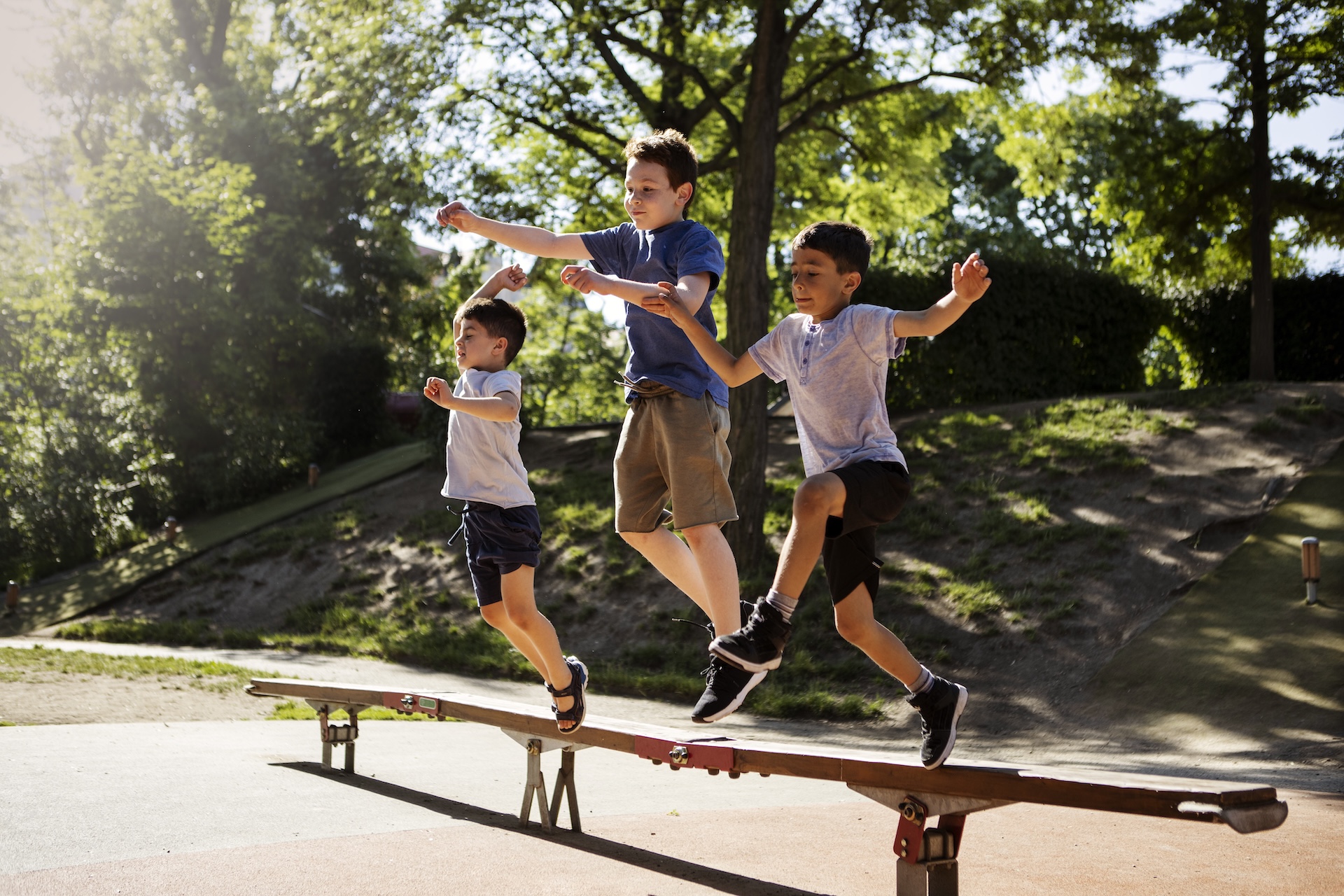
Players stand in a circle. The leader shouts, “Touch something blue: one, two, three!” And everyone runs to find something blue around them: the sky, a jacket, a bike, a swing.
Whoever is last, or doesn’t find the right color, is out. A simple game that can go on forever and only needs a voice.
8. Relay races: make them up yourself
Relay races are great because the rules can change every time. Run to a tree and back sideways. Or with a ball between your knees. Or with your eyes closed while someone guides you with their voice.
Kids usually start inventing their own variations. At that point, it becomes a game about inventing games.
9. Bring me…
Ask the child to find and bring something round. Or smooth. Or something that fits in a fist. Or something you can tickle with.
This game develops attention, observation, and imagination, and works anywhere: in the park, at the campsite, near the water. Each next request is a little harder than the previous one, and the kids naturally get into it.
10. Mini garden or garden decorations
If you’re at home or at a campsite with access to soil, give the child a small patch or a pot. Plant something simple together: radishes, peas, herbs. Explain why watering matters. Watch it together.
Or try something else: collect pretty stones and turn them into characters like birds, beetles, or berries using acrylic paint. It dries quickly, won’t wash away in the rain, and later decorates the garden or windowsill.
Players stand in a circle. The leader shouts, “Touch something blue: one, two, three!” And everyone runs to find something blue around them: the sky, a jacket, a bike, a swing.
Whoever is last, or doesn’t find the right color, is out. A simple game that can go on forever and only needs a voice.
8. Relay races: make them up yourself
Relay races are great because the rules can change every time. Run to a tree and back sideways. Or with a ball between your knees. Or with your eyes closed while someone guides you with their voice.
Kids usually start inventing their own variations. At that point, it becomes a game about inventing games.
9. Bring me…
Ask the child to find and bring something round. Or smooth. Or something that fits in a fist. Or something you can tickle with.
This game develops attention, observation, and imagination, and works anywhere: in the park, at the campsite, near the water. Each next request is a little harder than the previous one, and the kids naturally get into it.
10. Mini garden or garden decorations
If you’re at home or at a campsite with access to soil, give the child a small patch or a pot. Plant something simple together: radishes, peas, herbs. Explain why watering matters. Watch it together.
Or try something else: collect pretty stones and turn them into characters like birds, beetles, or berries using acrylic paint. It dries quickly, won’t wash away in the rain, and later decorates the garden or windowsill.
.png)